Daily Dark Web
  • Home
  • Data Breaches
  • Inside the Adversary
    • Dark Web Informants
  • DDW Top Lists
  • Ransomware News
  • DarkWeb News
    • Vulnerability
    • Cyber Attacks
  • Unauthorized Accesses
  • About Us
No Result
View All Result
  • Home
  • Data Breaches
  • Inside the Adversary
    • Dark Web Informants
  • DDW Top Lists
  • Ransomware News
  • DarkWeb News
    • Vulnerability
    • Cyber Attacks
  • Unauthorized Accesses
  • About Us
No Result
View All Result
Daily Dark Web
No Result
View All Result
Home Vulnerability

Threat Actor Claims to Sell “.url” Exploit Source Code for $10k

August 4, 2024
Reading Time: 2 mins read
Threat Actor Claims to Sell “.url” Exploit Source Code for $10k
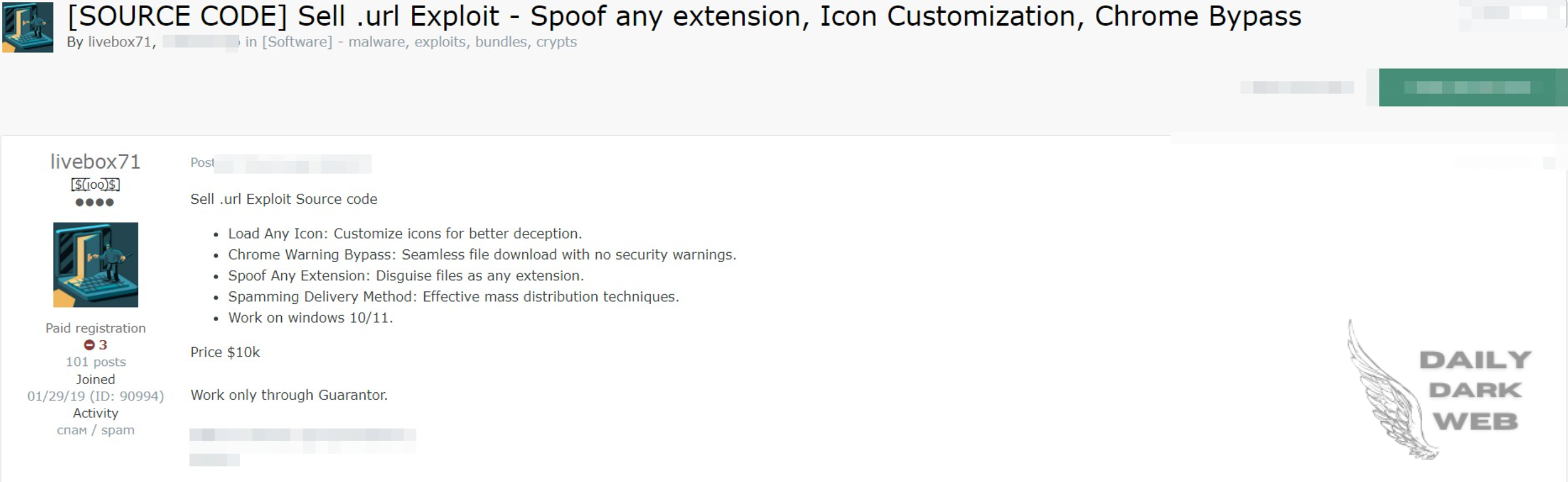
A threat actor has announced the sale of a .url exploit source code, claiming it offers several advanced features for deceiving users and bypassing security measures. The hacker claims the exploit is effective on Windows 10 and 11 systems.

Exploit Features:

  • Load Any Icon: Customize icons to enhance deception.
  • Chrome Warning Bypass: Seamless file download with no security warnings.
  • Spoof Any Extension: Disguise files as any extension for better concealment.
  • Spamming Delivery Method: Effective mass distribution techniques to spread the exploit widely.

Price: $10,000

The seller claims that the exploit can effectively deceive users and bypass security warnings, making it a potent tool for malicious activities. The exploit is advertised to work on the latest Windows operating systems, further increasing its potential impact.


A .url exploit leverages vulnerabilities associated with URL shortcut files in Windows operating systems. These files typically contain internet shortcuts, directing users to a specified web page. However, threat actors can manipulate these files for malicious purposes.

How a .url Exploit Works:

  1. File Composition:
    • A .url file is essentially a text file with a specific format that Windows recognizes as an internet shortcut. It contains sections like [InternetShortcut], URL=, and IconFile=.
  2. Manipulation:
    • Icon Customization: Attackers can customize the icon of the .url file to resemble legitimate files or applications, enhancing the deception and making it more likely for users to click on it.
    • Spoofing Extensions: The file can be disguised to appear as another type of file, such as a .doc or .pdf, misleading users about its true nature.
  3. Execution:
    • When a user clicks on the malicious .url file, it can trigger various malicious actions. For example, it could:
      • Redirect the user to a malicious website designed to exploit browser vulnerabilities.
      • Execute scripts or commands that download and install malware.
      • Exploit vulnerabilities in the handling of .url files by the operating system or specific applications.

Tags: ChromeexploitGooglelivebox71malwaresource codeWindows
ShareTweet

Related Posts

CPUID Website Compromised: CPU-Z and HWMonitor Serve Malware
Vulnerability

CPUID Website Compromised: CPU-Z and HWMonitor Serve Malware

April 10, 2026
Axios npm Package Compromised in Supply Chain Attack
Vulnerability

Axios npm Package Compromised in Supply Chain Attack

March 31, 2026
Critical Figma MCP Server Flaw Allows Remote Code Execution
Vulnerability

Critical Figma MCP Server Flaw Allows Remote Code Execution

October 8, 2025
Oracle Patches CVE−2025−61882
Vulnerability

Oracle Patches CVE−2025−61882

October 6, 2025
Shai-Hulud Worm Infects Over 500 NPM Packages in Sophisticated Supply Chain Attack
Vulnerability

Shai-Hulud Worm Infects Over 500 NPM Packages in Sophisticated Supply Chain Attack

September 17, 2025
WinRAR Zero-Day RCE Vulnerability Allegedly for Sale for $65,000
Vulnerability

WinRAR Zero-Day RCE Vulnerability Allegedly for Sale for $65,000

September 8, 2025
Next Post
South Korean Fitness Platform Allegedly Breached

South Korean Fitness Platform Allegedly Breached

Alleged Access Sale for a US Based Gambling Company

Alleged Access Sale for a US Based Gambling Company

Recommended Stories

Executive Aviation Targeted in Play Ransomware Attack

Executive Aviation Targeted in Play Ransomware Attack

March 16, 2026
Telcel Data Breach Raises Concerns Over Telecommunications Security in Mexico

Telcel Data Breach Raises Concerns Over Telecommunications Security in Mexico

January 2, 2025
Play Ransomware Group Allegedly Breaches Rite Track, Travancore Analytics, Bluewater Yacht Sales, and The Scharine Group

Play Ransomware Group Allegedly Breaches Rite Track, Travancore Analytics, Bluewater Yacht Sales, and The Scharine Group

August 12, 2025

Popular Stories

  • SudamericaData Breach Exposes Over 1TB of Argentine Records

    SudamericaData Breach Exposes Over 1TB of Argentine Records

    0 shares
    Share 0 Tweet 0
  • Threat Actor Claims Sale of Dell Database Containing 49 Million Customer Records

    0 shares
    Share 0 Tweet 0
  • SUUMO, CHINTAI, At Home, HOME’S Suffer Data Breach

    0 shares
    Share 0 Tweet 0
  • Financial Tech Giant SilverLake Axis Allegedly Breached – 423GB of Data for Sale

    0 shares
    Share 0 Tweet 0
  • Telekom Serbia Investigates Leak of 160,000 Customer Records

    0 shares
    Share 0 Tweet 0
Daily Dark Web

Disclaimer: Daily Dark Web (DDW) is an independent media platform providing information, analysis, and reporting on cybersecurity, cyber incidents, and related digital developments. All content published on this website is for informational and journalistic purposes only. DDW does not support, endorse, or promote any illegal activities, threat actors, or organizations referenced in its content. Any statements, claims, or opinions expressed by third parties, including interview subjects, are their own and do not reflect the views of DDW. Such content may include unverified information and should be interpreted critically. DDW does not participate in, facilitate, or coordinate any activities discussed or referenced on this platform. Under no circumstances should any content be interpreted as encouragement, instruction, or endorsement of unlawful actions. All interactions and publications are conducted in the public interest to enhance awareness and understanding of the evolving cyber landscape.

No Result
View All Result
  • About Us
  • Home
  • Newsletter
  • Privacy Policy

Disclaimer: Daily Dark Web (DDW) is an independent media platform providing information, analysis, and reporting on cybersecurity, cyber incidents, and related digital developments. All content published on this website is for informational and journalistic purposes only. DDW does not support, endorse, or promote any illegal activities, threat actors, or organizations referenced in its content. Any statements, claims, or opinions expressed by third parties, including interview subjects, are their own and do not reflect the views of DDW. Such content may include unverified information and should be interpreted critically. DDW does not participate in, facilitate, or coordinate any activities discussed or referenced on this platform. Under no circumstances should any content be interpreted as encouragement, instruction, or endorsement of unlawful actions. All interactions and publications are conducted in the public interest to enhance awareness and understanding of the evolving cyber landscape.

Are you sure want to unlock this post?
Unlock left : 0
Are you sure want to cancel subscription?